

Where applications become decisions
A shortlist is only useful if the route to it is clear. Once applications arrive, teams need to separate useful evidence from noise without turning every vacancy into a manual trawl.
Reach ATS keeps criteria, candidate evidence, feedback and progression together, giving recruiters and hiring managers a shared view while keeping the final decision with the people responsible for hiring.
From application to interview-ready shortlist
Set the criteria
Shortlisting for interviews starts with the evidence. Define the skills, experience, qualifications and screening evidence that matter for the role before your team starts comparing applications.
Screen the essentials
Review application answers, documents and configured requirements to understand who meets the essentials and where closer review is needed.
Understand candidate fit
Reach Intelligence can surface relevant skills, summaries and match scores, helping reviewers see useful evidence without relying on keyword matching alone.
Review more fairly
Reach supports blind shortlisting. Use structured criteria and anonymised screening where appropriate, helping early decisions focus more consistently on evidence from the application.
Decide together
Recruiters and hiring managers can add scores, notes and feedback inside Reach, giving everyone the same candidate picture before progression.
Progress the shortlist
Move suitable candidates forward individually or in bulk, trigger the next workflow actions and keep applicants informed as the process continues.

Start with the evidence that actually matters
Shortlisting becomes inconsistent quickly when every reviewer is looking for something different.
Reach ATS lets teams use role-specific screening questions, criteria and scorecards, giving reviewers a shared framework for assessing the evidence that matters to that vacancy rather than relying on instinct alone.

Let the strongest signals rise first
High application volumes can make relevant experience surprisingly easy to miss, particularly when reviewers are working across CVs, forms and supporting documents.
Reach Intelligence can analyse skills, experience and role requirements to provide fit-to-role scores and supporting insight, helping teams focus their attention while keeping progression decisions with the reviewer.

Give reviewers the picture, not another pile of tabs
Useful evidence can be scattered across a CV, application form, screening answers and supporting documents.
Reach Intelligence can bring relevant skills, experience and qualifications into a concise candidate summary, with reasoning reviewers can check against the underlying application.

Take identity out of the first impression
The first review should be about evidence, not assumptions.
Reach ATS supports anonymised screening and redacted candidate information, helping teams assess applications against the role before personal details influence the conversation. Structured criteria give reviewers a more consistent basis for comparison.

Give everyone the same candidate picture
Shortlisting gets harder when decisions are spread across inboxes, spreadsheets and separate conversations.
Recruiters and hiring managers can review candidates, capture scores and feedback, and work through assigned tasks inside Reach, keeping the shortlist visible and easier to move forward together.

Move fifty applications without fifty individual clicks
Higher volumes should not turn a good shortlisting process into repetitive administration.
Bulk actions and automated workflows help teams progress, hold or communicate with groups of candidates efficiently, while the underlying criteria and decisions remain visible inside Reach.

AI helps with the evidence. Your team makes the call.
Reach Intelligence can rank, summarise and surface relevant evidence, making a large candidate pool easier to navigate.
Reviewers can examine the information behind a recommendation, compare candidates and decide who progresses. The technology supports the judgement; it does not own the outcome.
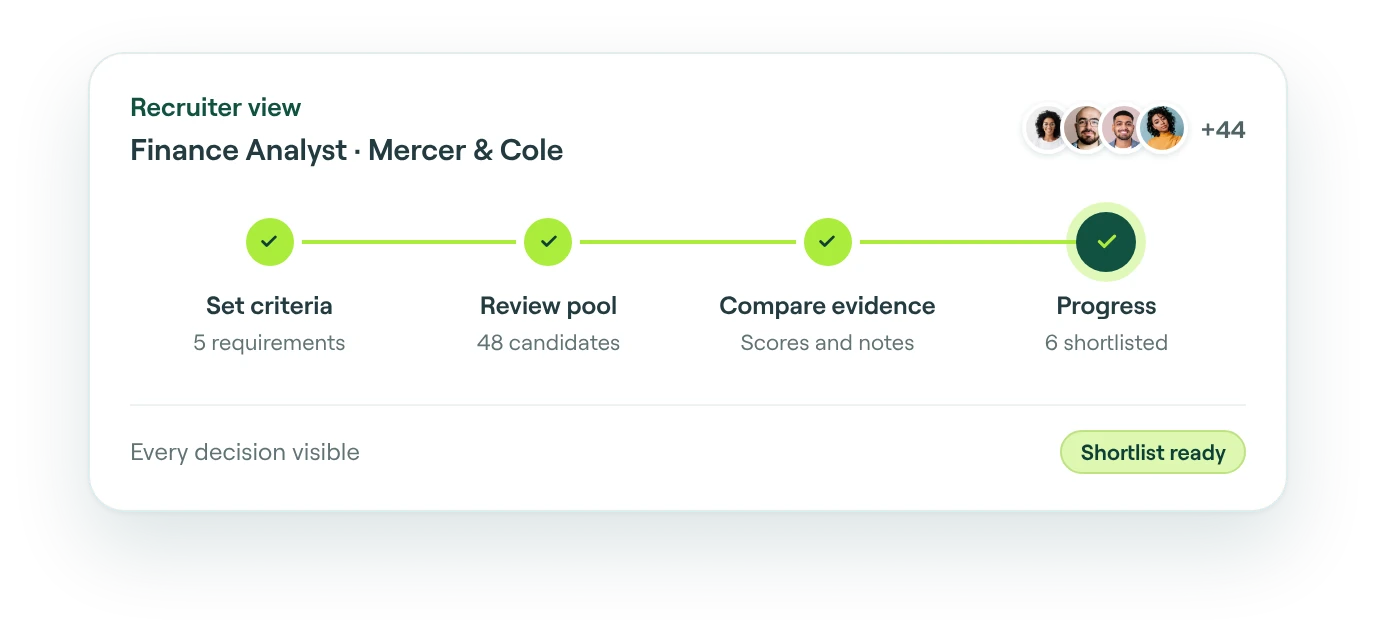
Recruiters set the structure. Hiring managers add the context.
For your recruitment team
Define the criteria, keep the candidate pool visible and coordinate how applications move through the process.
Reach keeps screening evidence, feedback and progression together so the team can see what has happened, what still needs attention and where each candidate stands.
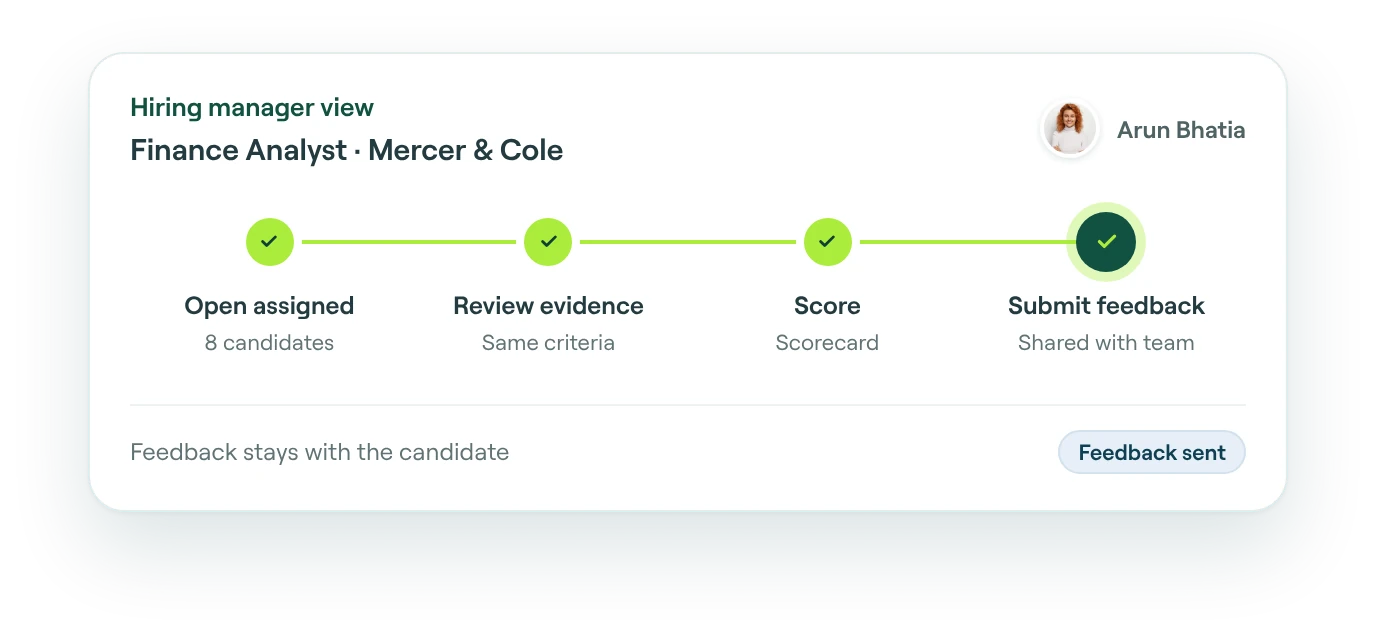
For hiring managers
Review the candidates relevant to your vacancy through a focused experience, using the same criteria and candidate evidence as the recruitment team.
Scores, notes and feedback stay connected to the candidate rather than disappearing into email threads or separate documents.
Different roles need different evidence.
Reach ATS can adapt screening depth, criteria and reviewer involvement around the vacancy, so shortlisting reflects what the role genuinely requires.
High-volume and frontline
Regulated roles
Specialist roles
Senior appointments
Internal opportunities
Graduate & early careers
Apprenticeships & internships
Volunteering & community roles
Everything you can use for shortlisting
Explore the Reach ATS tools that help turn an application pool into a shortlist your team can stand behind.

Candidate Scorecards
Use shared scoring criteria to make candidate reviews clearer, more consistent and easier to compare.

Anonymised Screening
Reduce the visibility of identifying details during early candidate review, helping teams focus on relevant skills and experience. Fairer review. Human decisions. Candidate information protected.

Application and CV Viewer
Review candidate applications, CVs and feedback in one clear view, without jumping between separate files.

Automated Screening and Routing
Use agreed application criteria to screen candidates consistently and guide them towards the right next step.

Structured Screening Feedback
Capture consistent feedback from recruiters and hiring managers, then keep it connected to the candidate record.

The shortlist is ready. Now make the meeting count.
Shortlisting identifies the people your team wants to know more about.
The Interview stage brings scheduling, candidate coordination, structured assessment and feedback together so you can move from promising application to better-informed decision.
Bring clearer evidence into every shortlisting decision
FAQs
Candidate shortlisting is the stage where applications are reviewed against the requirements of the vacancy and the recruitment team decides who should progress. Reach ATS keeps candidate evidence, screening criteria, feedback and progression within the same hiring process.
Yes. Screening questions, scorecards, criteria and workflows can be configured around the requirements of different roles rather than forcing every vacancy through the same review process.
Reach Intelligence can analyse candidate information, surface relevant skills and experience, generate summaries and provide fit-to-role scores that help reviewers work through applications more efficiently.
No. Reach’s AI capabilities support human decision-making. Recruitment teams and hiring managers remain responsible for deciding which candidates progress.
Yes. Candidate summaries and supporting evidence help reviewers understand the information behind AI-assisted insight rather than relying on a score alone.
Yes. Reach supports anonymised screening and redacted candidate information to help teams focus early-stage review on relevant evidence rather than personal identifiers.
Yes. Hiring managers can be given access to relevant candidate information and recruitment activity, allowing them to contribute scores, feedback and screening decisions within the process.
Yes. Bulk actions can help recruitment teams progress or update groups of candidates together when handling larger application volumes.
Yes. Teams can use predefined role criteria, screening questions and scorecards to create a more consistent framework for reviewing candidate evidence.
Candidates selected to progress move into the Interview stage configured for the vacancy, where the team can coordinate scheduling, assessment and feedback.