When every department hires differently

Posted: 23 Nov 2026
Two colleagues are sat at a desk in discussion about what is on a laptop screen.

Why flexing your approach doesn’t mean surrendering control.

“Every department we have hires differently”.

When you say it out loud, it sounds a little bit like the Wild West, doesn’t it? You can almost picture departmental hiring managers out there searching for candidate gold, each doing things their own way and perhaps even taking out the competition with a six-shooter!

But is allowing different departments to take different approaches to hiring really such an ‘out there’ idea?

Not necessarily. In fact, giving departments the flexibility to shape their own hiring processes can be a positive thing, provided it’s done in partnership with HR, aligns with organisational standards and protects the employer brand.

There are, of course, situations where hiring inconsistencies may have crept in over time – perhaps because individual hiring managers prefer doing things their own way – and that type of  ‘drift’ should certainly be addressed. But for most organisations, enabling different approaches to hiring allows each department to recruit in a way that works for them.

The challenge for HR and TA teams is to know where hiring differences are necessary and where they have simply developed over time or out of habit. Designing a hiring process that accommodates every possible requirement can make things unnecessarily complicated. Equally, allowing each department to establish its own hiring rules can create an entirely different set of problems – and then we’re back in the Wild West.

So how much flexibility should departments have when it comes to deciding their recruitment process, and who gets to decide?

When does it make sense for departments to hire differently?

There are plenty of legitimate reasons for departments to recruit differently. Like distinct micro-organisations, departments often have their own talent markets, technical demands and operational pace.

Some departments will use external recruitment agencies for niche or specialist roles. Others may use mainstream channels, local job boards or career fairs. Some roles require extensive technical assessments which might be completely irrelevant to other departments.

From continuous high-volume hiring driven by high-turnover or seasonal spikes to executive recruitment that requires a slower, high-touch approach, every department is governed by its own needs, pace and candidate markets.

Rather than trying to force an entire organisation into a ‘one-size-fits-all’ workflow, the aim is a process that fits each department’s individual needs, while still maintaining the standards and consistency expected across the organisation.

Karina Lee, Senior Internal Recruiter at LCP, leads a small team supporting multiple departments, ranging from pensions actuaries and insurance actuaries to data scientists. Her team works closely with each department to understand what each role requires and builds a process around the role.

“If I could have one kind of process for 15 or 16 departments that would be the dream!” says Karina, “But in reality that’s just not feasible or viable… part of our job here is to work with the departments to ensure that their process enables them as a department, and us as a business to hire the best people that we can.”


Webinar

Consistency in recruitment doesn't mean identical recruitment workflows

Karina Lee, Senior Internal Recruiter at LCP, explains how different roles and departments may need different approaches, but every candidate deserves clear communication and respectful treatment. 

Recruitment stages: What needs to stay consistent?

If departments have different recruitment requirements, standardising every stage isn’t necessarily the answer. If one role needs an assessment centre, another a practical skills test and a third a single structured interview, forcing all three through an identical selection process will likely create unnecessary work without improving hiring decisions.

What can differ What should remain consistent
Number and format of interviews Fair job-related assessment criteria
Role-specific assessments Documented and defensible selection decisions
Additional departmental approvals Agreed levels of authority and accountability
Overall time to hire Clear and accurate candidate communication, with agreed response times.
Which compliance checks apply to a role Completion of all applicable legal and organisational requirements
Departmental reporting requirements Consistent definitions for organisation-wide recruitment metrics


Two candidates applying to different departments don’t necessarily need identical journeys. But they do need to be assessed fairly, understand what’s expected of them and receive appropriate communication throughout the process.

Employer brand is part of those standards. A hiring manager recruiting for a warehouse role and one recruiting for a finance role may take candidates through very different recruitment stages, and that’s how it should be. What shouldn’t change is how the candidate feels about your organisation at the end of it. Tone of voice, courtesy, clarity and the promises made on your careers site and in your job adverts should hold true whichever route someone takes. Different recruitment stages are a process decision. A consistent experience is a brand decision.

Consistency is less about making every recruitment journey look the same, and more about maintaining the standards, and the brand, that sit behind it.

Who gets to change the hiring process?

Hiring managers understand the requirements of the roles they are hiring for. They know their team dynamics; the skills needed for the vacancy and the operational pressures that surround a vacancy better than anyone. Giving them autonomy to recruit effectively is important, but there’s an important distinction to be made between managing their own recruitment activity and having the authority to change the hiring process itself.

Giving hiring managers autonomy doesn’t have to mean giving them carte blanche with an organisation’s hiring process. It means allowing hiring managers the flexibility to adapt a process that’s already in place to better suit their roles.

Using the right applicant tracking software (ATS) allows HR and Talent Acquisition teams to lock in core processes and flag where recruitment stages can be adapted. This lets HR retain control and oversight and gives hiring managers the freedom to hire in a way that suits their vacancies.

Decisions hiring managers can make independently

Decisions hiring managers could (and should) be making include reviewing candidates against agreed criteria, selecting interview times, providing assessment feedback and progressing vacancies through authorised stages. HR still sees everything that happens, and all actions are recorded for audit, but HR doesn’t have to become involved with decisions that, ultimately, sit best with those hiring for the role.

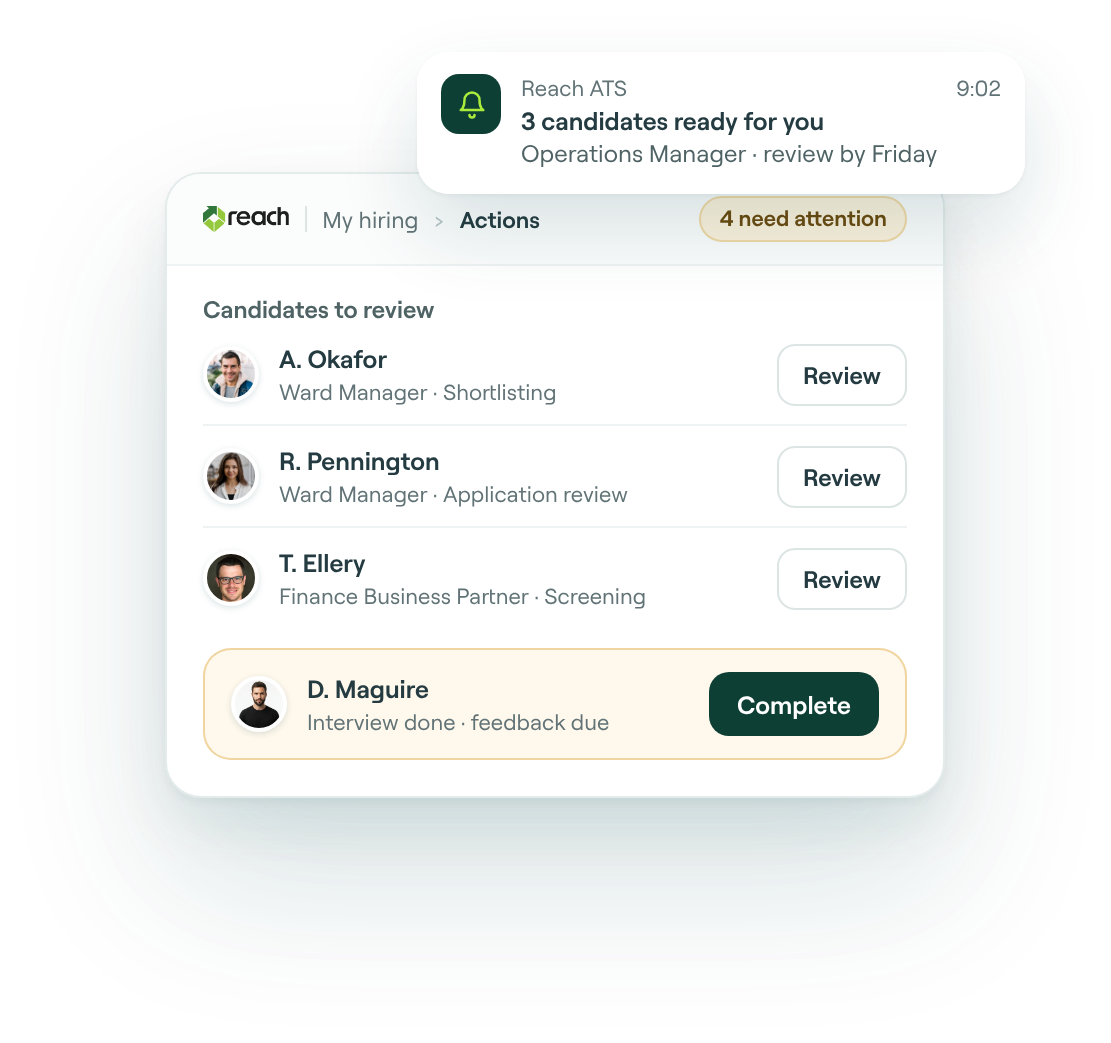
In an ATS, that autonomy has a natural home: a hiring manager portal gives managers a dedicated place to review candidates, arrange interviews and move candidates forward, without needing HR manage every step. These personalised portals mean managers only see the roles they’re responsible for, while task alerts and notifications provide an instant overview of the progress of all their live vacancies.

Decisions that require agreement

Changes that go beyond what’s been built into the workflow should always be agreed before they happen. That might include adding another interview round, changing an assessment method or introducing another stakeholder. All of these process-affecting stages require a discussion with HR or Talent Acquisition, and that matters even more if a vacancy is live, because candidates already in the process should be assessed on the same basis.


Decisions governed by organisational policy

While flexibility is key to successful devolved hiring, there are some decisions that should always be governed by organisational policy. These tend to be decisions that might impact the organisation and the employer brand. For example, approval authority, mandatory checks, data handling requirements and recruitment compliance standards should never be at the whim of individual department preferences.

While the type of pre-employment checks needed may vary, how they’re carried out and recorded shouldn’t. Right-to-work checks, DBS checks, audit trails and data handling are always best handled inside the process, not bolted on, so they happen the same

Candidate communications sit at this level too. Standardised messages, response times and feedback protocols are all policy-level commitments that need to be consistent across the board.

One recruitment workflow, with room for each team

These three levels of decision-making outlined above – decisions hiring managers can make, those that require agreement and those governed by organisational policy – only work if they’re built into how hiring actually happens, rather than written into a policy document. That’s what a shared recruitment workflow is for.

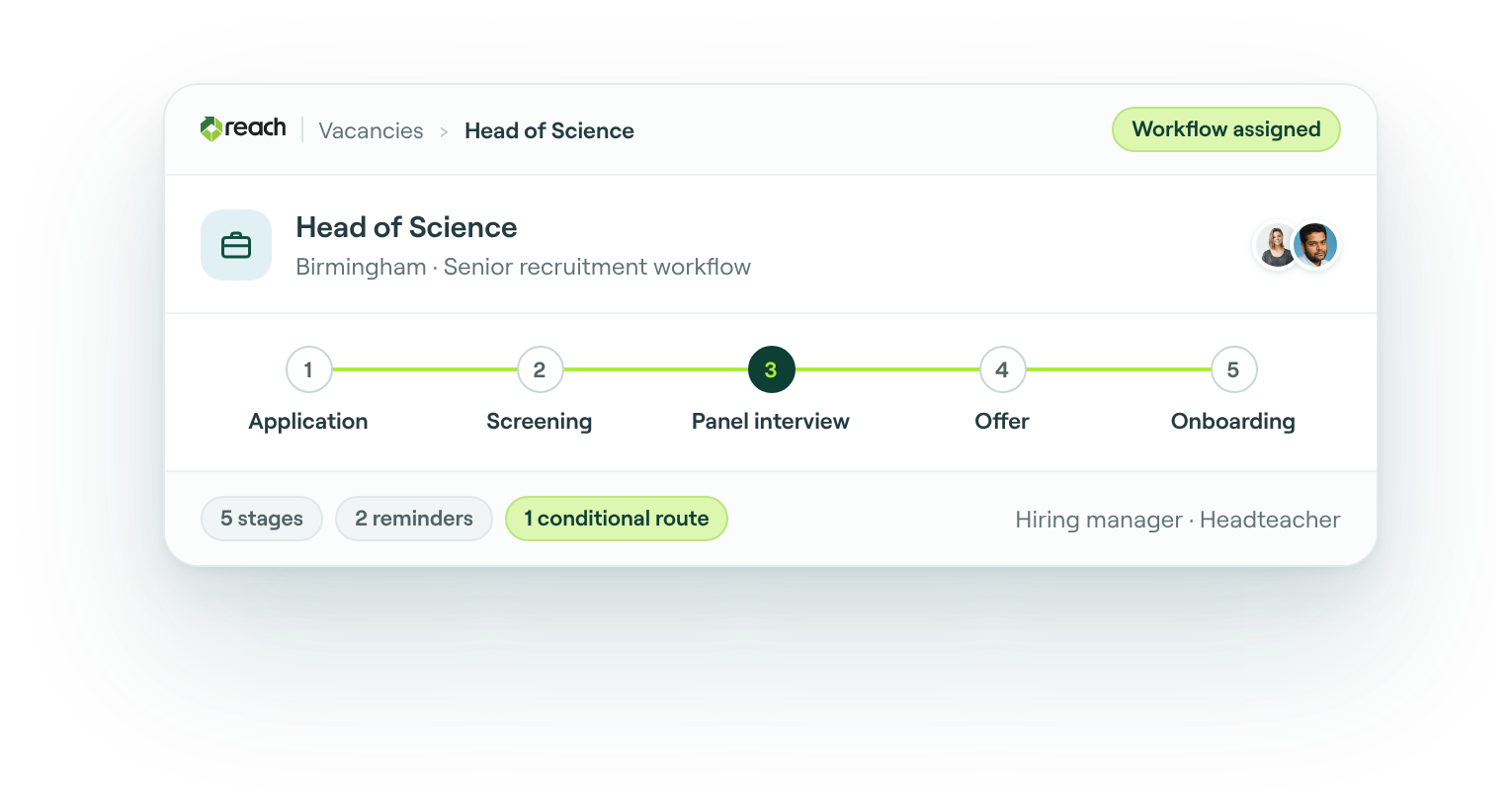
Think of it as a core set of recruitment stages that every vacancy passes through, but with flexibility built in. From requisition and screening through to interviews and offer, departments can take different routes within the same recruitment process while keeping shared approvals and records. Within those limits, hiring managers can run their own vacancies without asking permission each time.

In other words, the three levels of decision-making become the structure of the workflow, not a set of rules people have to try to remember. You can read more about workflow management with Reach ATS here.

One talent acquisition process, but are you comparing like with like?

Your departments are hiring differently to suit their needs. Your workflows are governed by your three-tier decision-making process. And your recruitment is ticking along nicely –  or is it?

Even if your ATS gives you visibility of recruitment activity across every department, visibility alone only tells you so much. If the data being collected isn’t consistent or comparable, it becomes much tougher to build a true picture of how well your recruitment processes are going.

Reporting by department and recruitment stage can show where hiring is working well and where it’s stalling. But reporting that ignores the context behind numbers can point you in the wrong direction.

Imagine two departments with very different hiring times:

Dept. A has an average time to hire of 5 days Dept. B has an average time to hire of 17 days
Dept. A typically recruits operational staff through a short application and interview process. Dept. B recruits specialist professionals through technical assessments, panel interviews and several approval stages.


If Department A fills vacancies considerably faster, does that mean its recruitment process is more efficient?

When roles, candidate markets, assessment requirements and decision-making structures are entirely different, looking at overall time to hire without acknowledging those differences risks drawing the wrong conclusions.

The same issue of course applies to other recruitment measures:

A department with a higher interview-to-offer ratio may be assessing candidates differently. A team with longer approval times may have additional governance requirements. Another department might have fewer recruitment stages but experience repeated delays because hiring managers struggle to make themselves available, or because they are interviewing large numbers of people for each role and decision-making is delayed.

None of these situations can be understood properly from a headline figure alone.

When HR and TA leaders are interrogating recruitment data, the more useful questions are often:

  • Where is time actually being spent within each department’s recruitment process?
  • Which delays are necessary consequences of the role requirements, and which are avoidable?
  • Are departments measuring recruitment activity using the same definitions?
  • Are differences in performance caused by the process, the vacancy or the people involved?

There are other potential discrepancies that might also fly under the radar:

An organisation measures time to hire from the point a vacancy is approved. If one department records approval when the budget is authorised and another after the hiring manager has completed the requisition, the resulting figures are not directly comparable. Reporting reliability can be affected by these small differences, even when everyone uses the same.

A shared talent acquisition process needs more than central access to information. It needs agreed definitions and enough detail to explain what the numbers actually represent. Comparing similar roles or analysing individual recruitment stages may reveal more than ranking departments by their overall hiring speed.

When a department consistently takes longer to recruit, the aim shouldn’t be to automatically remove stages; it should be to review why. An additional assessment might be entirely justifiable if it provides valuable evidence for a hiring decision. Equally, an approval stage that adds several days without contributing anything meaningful deserves closer examination.

Regular departmental reviews help. Compare each department with its own previous performance before comparing it with others. Reliable reporting shows whether recruitment stage timings, candidate drop-out patterns and feedback are improving or worsening, giving cross-department comparisons meaningful context.

Different requirements, shared standards

There’s a clear distinction between a department hiring differently and a department that’s hiring however it likes. With different operational requirements and roles to hire for, there’s no reason every department should follow an identical recruitment process. In fact, trying to impose one rigid route across an organisation can introduce as many problems as it solves.

A more flexible model, supported by agreed standards around who can change what, what stays the same for every candidate and how performance is measured, gives hiring managers autonomy without losing control.

After all, giving departments the freedom to hire in their own way doesn’t mean giving them free rein. It’s about finding the right balance between flexibility and control.

The right ATS helps HR teams lock in these standards, while allowing hiring managers to adapt workflows by department, role or contract type.

This level of hiring manager autonomy creates space for HR teams to focus on recruitment performance. And with the right data reporting in place, HR can see what’s really happening in each department.

If you’d like to find out how Reach ATS can help your departments hire differently, reach out and book a demo today.